Power Unit Certification Guide for Compliance
Posted by Liz Roth on Apr 8th 2026
Power Unit Certification: Why ETL and UL Matter More Than Ever
Why Power Unit Certification Is No Longer Optional
Power units are often treated as commodity components in waste and recycling operations.
But in reality, they are electrical equipment installed at customer facilities—including hospitals, warehouses, grocery chains, and large commercial sites.
While they are not part of a building’s core electrical system, they operate alongside it, and are subject to the same inspection and safety expectations.
That distinction matters.
If a power unit fails—or doesn’t meet local electrical code—the consequences can extend far beyond equipment downtime to include failed inspections, operational disruption, and liability exposure.
What ETL and UL Certification Actually Mean
Certification through recognized organizations like UL (Underwriters Laboratories) and Intertek (ETL) ensures that a power unit has been independently evaluated for safety and compliance.
These certifications fall under the OSHA Nationally Recognized Testing Laboratory (NRTL) framework.
A certified power unit has been:
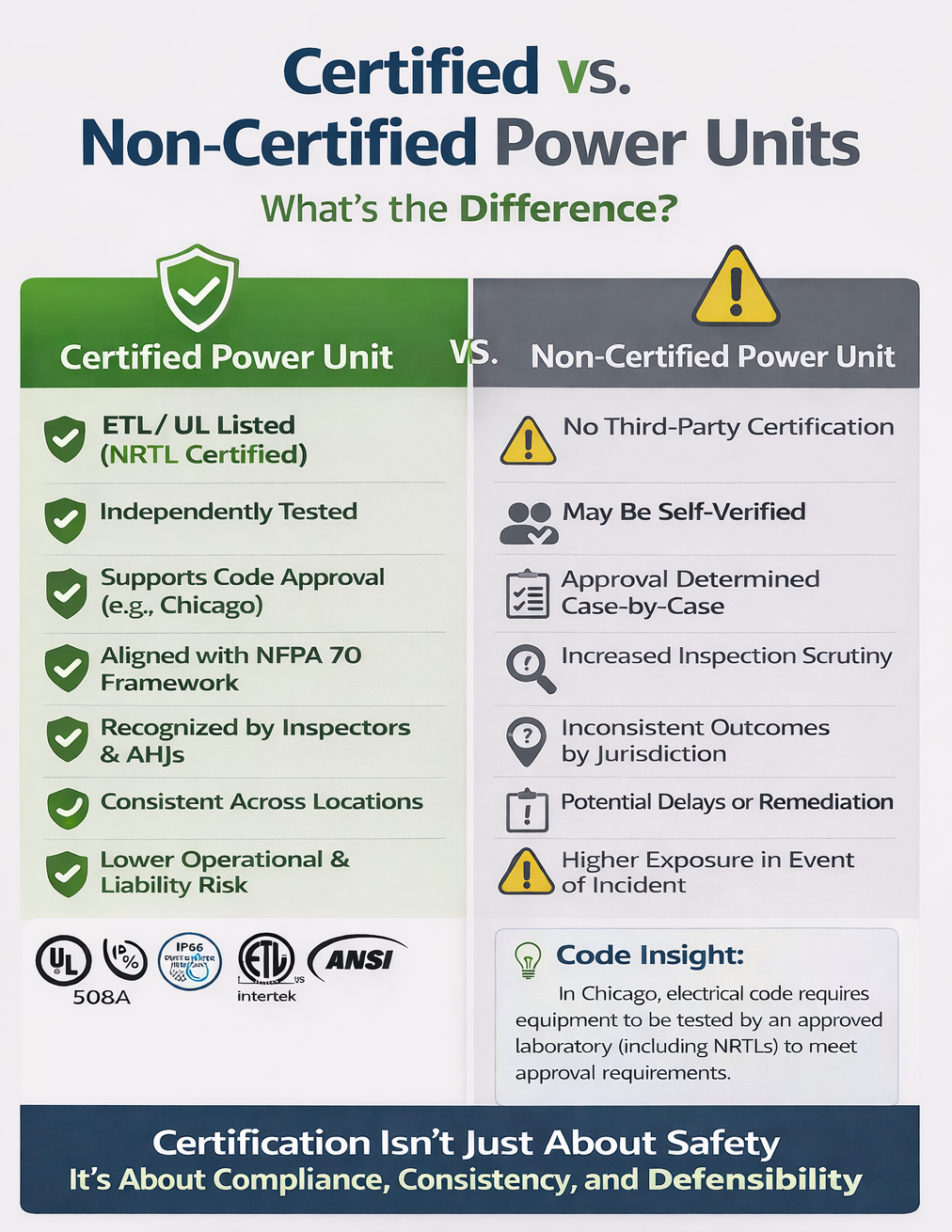
- Independently tested against recognized safety standards
- Evaluated for electrical integrity, grounding, and protection
- Verified for safe operation in commercial environments
This is not self-declared compliance—it is third-party validation that stands up during inspection.
The Risk for Haulers Leasing Equipment
For haulers, the risk profile changes the moment equipment is placed on a customer’s site.
You are not just delivering a compactor—you are deploying powered equipment that operates within a regulated environment.
If a non-certified power unit contributes to:
- Electrical failure
- Fire
- Equipment malfunction
- Injury or electrocution
…the investigation will quickly shift to compliance.
And specifically:
Was the equipment properly tested and certified to meet applicable electrical standards?
If the answer is unclear, the liability exposure can extend directly to the hauler.
Local Code, AHJs, and Why Certification Speeds Approval
Electrical requirements for equipment used in commercial environments are typically enforced by the Authority Having Jurisdiction (AHJ).
Even though power units are not part of the building’s electrical infrastructure, they are still:
- Installed at the site
- Connected to electrical supply
- Subject to inspection and approval
Most jurisdictions align with standards derived from NFPA 70 (National Electrical Code).
Certified equipment helps by:
- Providing a clear basis for approval
- Reducing back-and-forth during inspection
- Standardizing acceptance across locations
- Minimizing delays
Without certification, approval often becomes:
- Case-by-case
- Documentation-heavy
- Inconsistent across jurisdictions
ETL vs UL: What’s the Difference?
Both ETL and UL certifications indicate that a product meets established safety standards.
| Certification | Organization | Key Point | ||
|---|---|---|---|---|
| UL Listed | Underwriters Laboratories | Long-standing global recognition | ||
| ETL Listed | Intertek | Equivalent NRTL certification |
For inspectors and operators, both marks signal the same thing:
The equipment has been independently tested and meets accepted safety standards.
The Hidden Cost of Non-Certified Power Units
Non-certified power units may appear more cost-effective upfront—but they introduce real operational risk:
- Inspection delays or rejections
- Additional documentation requirements
- Inconsistent approvals across locations
- Increased liability if an incident occurs
For haulers servicing high-profile environments like hospitals, distribution centers, and national retailers, these risks can quickly outweigh any initial savings.
Why Leading Operators Are Standardizing on Certified Units
More operators are choosing to standardize ETL or UL-certified power units across their fleets.
Not because every jurisdiction explicitly requires it—but because it creates:
- Consistency across markets
- Faster, more predictable approvals
- Stronger defensibility during inspections and incidents
- Reduced operational friction
In short:
Certification simplifies compliance—and reduces uncertainty.
Final Takeaway
Power units may not be part of a building’s electrical system—but they are still electrical equipment operating within regulated environments.
And that’s what matters.
The question isn’t just whether the unit will run.
It’s whether it will pass inspection, meet expectations, and hold up under scrutiny if something goes wrong.
ETL and UL certification help ensure that answer is yes.
